2026 How to Choose the Right Step Motor for Your Project?
Choosing the right Step Motor is crucial for any project. Understanding the specific requirements can guide your decision. Step Motors are widely used in robotics, automation, and precise positioning tasks. They provide reliable control in various applications.
When selecting a Step Motor, consider torque, speed, and resolution. Matching these specifications with your project’s needs can be challenging. Each motor type has its strengths and weaknesses. A miscalculation may lead to performance issues or project failure. It's vital to analyze your application in detail.
Many factors affect the performance of Step Motors. Heat dissipation, power supply, and control method all play roles. Overlooking these aspects can result in inefficiencies or reduced lifespan. Indeed, even experienced engineers may overlook these details. Embracing a thorough evaluation process can enhance successful project outcomes.
Understanding Step Motors: Types and Applications
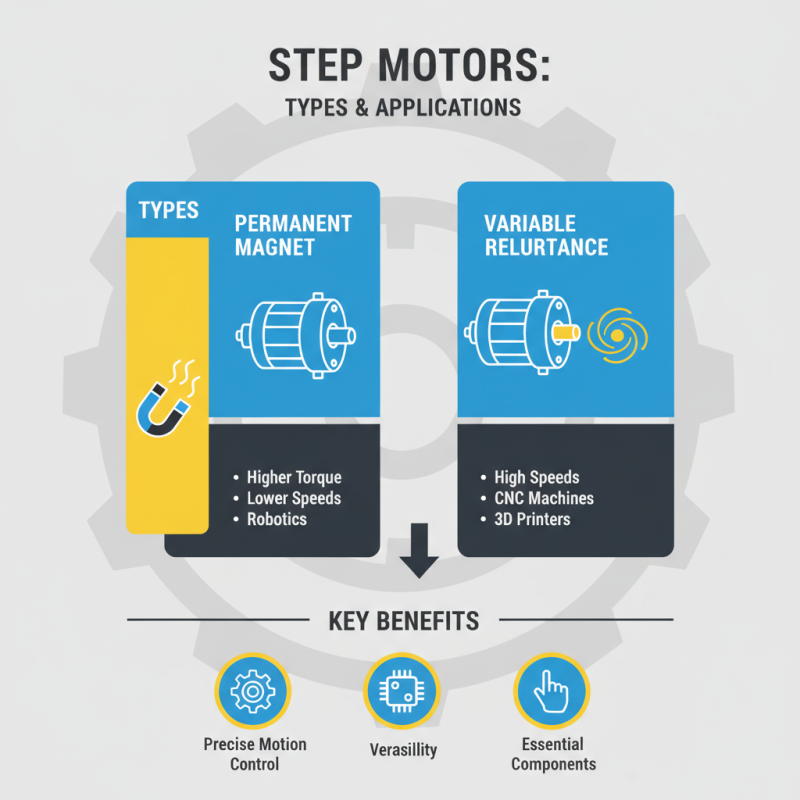
Step motors are essential components in various applications. They offer precise control of movement, making them ideal for robotics, CNC machines, and 3D printers. Understanding their types can significantly impact your project. There are mainly two types of step motors: permanent magnet and variable reluctance. Each has unique characteristics. Permanent magnet units provide higher torque at lower speeds. Variable reluctance motors, on the other hand, excel in high-speed applications.
Choosing the right motor isn't always straightforward. One must consider several factors, like torque requirements and speed. For instance, if your project demands high precision but operates at low speeds, a permanent magnet step motor may be suitable. However, they can sometimes struggle with high-speed performance. In contrast, variable reluctance motors can handle speed well, but torque might be insufficient in some scenarios.
Reflecting on your project's needs is crucial. Sometimes, going for the most popular motor isn't the best choice. It’s essential to test different motors to see how they perform under specific conditions. This hands-on approach can reveal shortcomings in your initial selection. The right motor can make or break the functionality of your project.
Key Specifications to Consider in Step Motor Selection
Selecting the right step motor for your project is crucial. Understanding key specifications will guide your decision. First, consider torque. It's essential for your application. High torque is vital for heavy loads. If you underestimate it, performance will suffer.
Another vital specification is step angle. Smaller angles provide better precision. However, they may slow down your motor. Balance between speed and accuracy is key. A motor that is too fast may lead to missed steps. A slow motor could delay your project.
Tip: Research your application's requirements. Think about load, speed, and necessary precision. Test different models if possible. It helps to narrow down your choices. Don’t rush the decision. Sometimes, less is more. A simple motor can outperform a complex one if chosen wisely. Consider energy consumption as well. An efficient motor saves power and reduces heat.
2026 How to Choose the Right Step Motor for Your Project? - Key Specifications to Consider in Step Motor Selection
| Specification |
Details |
| Step Angle |
1.8° (200 steps/revolution) |
| Holding Torque |
0.5 - 5.0 Nm |
| Rated Current |
1.0 - 3.0 A |
| Supply Voltage |
12V - 48V |
| Phase Type |
Bipolar or Unipolar |
| Weight |
0.5 - 3.0 kg |
| Shaft Diameter |
5 mm - 10 mm |
| Resolution |
200 - 400 steps/rev |
Assessing Load Requirements for Your Step Motor Project
When selecting a step motor, assessing load requirements is crucial. The load a motor must handle greatly affects its performance. According to industry reports, around 45% of project failures are attributed to improper load assessments. A miscalculation can lead to insufficient torque, resulting in stalled motors or, worse, complete failure.
Understanding your project's specific needs is essential. For instance, consider the weight and size of the components the motor will drive. A typical NEMA 23 stepper motor provides around 1.8 Nm of holding torque. However, this may not be sufficient for heavier applications. It’s vital to balance speed and torque to avoid underperformance.
Additionally, environmental factors can impact load requirements. High temperatures can reduce torque, while excessive vibrations can affect stability. Engineers should always account for these variables. The interplay between load and environmental conditions can complicate design decisions. Ultimately, the careful consideration of these details can lead to more successful outcomes in step motor projects.
Load Requirements for Step Motors in Different Applications
This chart represents the load requirements in Newton-meters (N·m) for various applications utilizing step motors. Understanding these requirements is crucial for selecting the right step motor for your project.
Choosing the Right Driver and Control for Your Step Motor
When selecting a step motor, choosing the right driver and control is crucial. The driver impacts the motor's performance directly. A good driver ensures higher torque and smoother motion. Reports indicate that improper driver selection can lead to a 30% decrease in efficiency in some cases. This highlights the importance of understanding the specifications of both the motor and the driver.
Control strategies also play a significant role. Depending on the application, different control methods may be more suitable. For example, open-loop control is simpler and cost-effective but lacks precision. Closed-loop control offers feedback for accuracy, making it more desirable for complex tasks. According to industry data, roughly 40% of issues in step motor applications stem from mismatched control systems.
However, finding the ideal combination can be challenging. Often, users face compatibility issues, resulting in unexpected performance. Many engineers overlook the importance of power supply compatibility, which can lead to overheating and failures. This requires careful consideration and sometimes, trial and error. Understanding these factors is essential to make informed decisions in project design.
Integrating Step Motors into Your System: Best Practices
Integrating step motors into your system is a crucial step in achieving precise motion control. Choosing the right step motor is vital for optimal performance. Ensure that the motor's torque specifications match your application needs. Overestimating torque can lead to inefficiencies. On the other hand, underestimating it may cause stalling. Calculating the load carefully can prevent these issues.
Wiring and connections are often overlooked. Poor connections can lead to erratic behavior. Ensure the wires are properly insulated and secured. Using shielded cables can help reduce electromagnetic interference. Positioning the motor correctly within the system also plays a significant role. It should be mounted securely to avoid vibrations. Unstable installations can lead to unexpected results in motion.
Considering thermal management is essential too. Step motors generate heat, and excessive temperatures can affect performance. An inadequate cooling solution may lead to motor failure. Pay attention to the environment where the motor operates. Sometimes, upgrades are necessary to address these shortcomings. Feedback systems may also enhance the precision of motion. Explore these options to ensure a successful integration.